Greetings from Phuket, Thailand! Welcome to Calypso Divers - join us onboard for scuba diving around Phuket, Phi-Phi and the world-famous Similan Islands & Richelieu Rock.
Monday, October 8, 2012
*Fascinating Fish Fact*
Hermit crabs are decapod crustaceans of the superfamily Paguroidea. Most species have long, curled abdomens, which are soft, unlike the hard abdomens seen in related crustaceans. The abdomen is protected from predators by a salvaged empty seashell carried by the hermit crab, into which its whole body can fit. The tip of the hermit crab's abdomen is adapted to clasp strongly onto the shell.
As the hermit crab grows in size, it has to find a bigger shell and abandon the previous one. Several hermit crab species, both terrestrial and marine, use "vacancy chains" to find new shells - when a new, bigger shell becomes available, hermit crabs gather around it and form a sort of queue from largest to smallest. When the largest crab moves into the new shell, the second biggest crab moves into the newly vacated shell, thereby making its previous shell available to the third crab, and so on.
Most species are aquatic and live in varying depths of saltwater, from shallow reefs and shorelines to deep sea bottoms. Tropical areas host some terrestrial species, though even those have aquatic larvae and therefore need access to water for reproduction. Most are nocturnal.
A few species do not use a "mobile home" and inhabit immobile structures left by polychaete worms, vermetid gastropods, corals and sponges
* There are over 600 species of hermit crabs in the world.
* Hermit crabs can live as long as 15 years although the majority of them live to around 6-8 years.
* Hermit crabs are not really classed as crabs due to the fact that they do not own their own shell.
* The Coconut crab or Birgus Latro is the largest hermit crab in the world with a size of up to 40 cms and a weight of up to 4.1 kgs!
* The shape of the shell that a baby hermit crab chooses determines the shape of its abdomen.
* Hermit crabs are fussy about the type of shells that they choose and are drawn to ones with mother of pearl linings.
* Hermit crabs drink by dipping their claws in water and depositing the water into their gills and mouth.
* Its nearest relatives are spiders and lobsters.
* Hermit crabs are not fussy eaters and will eat such things as fresh fruit and vegetables as well as small amounts of meat and fish.
* The Ecuadorian land crab is one of the smallest species of hermit crab at around 12mm in length
* Of all the species of hermit crab, only a few are generally classed as land or terrestrial and even these are born in the sea or ocean
* Hermit crabs moult as they grow, which means that they shed their exoskeleton and grow a new one. They will often consume their old skin for its nutrients.
* The abdomen of a hermit crab can change shape to fit the body of the shell that it is taking over. This is very good especially if the shell is of a spiral nature!
* If a land based hermit crab was left underwater for too long it would drown, even though it was born under water!
Friday, October 5, 2012
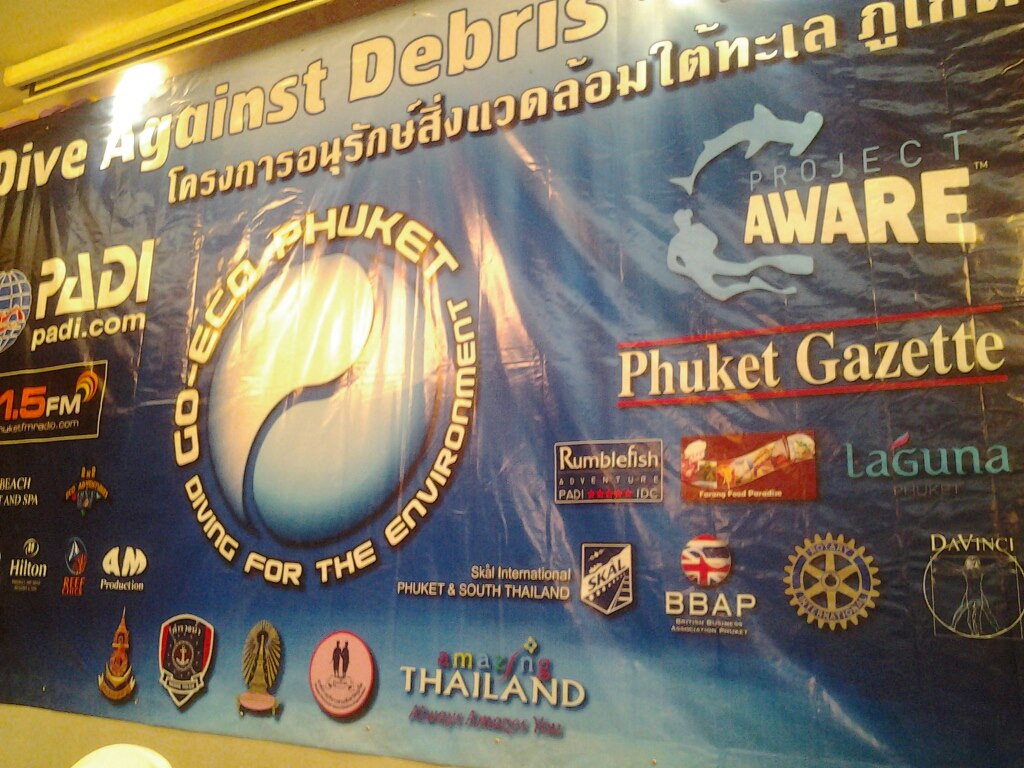
Great Success for Go Eco Phuket!
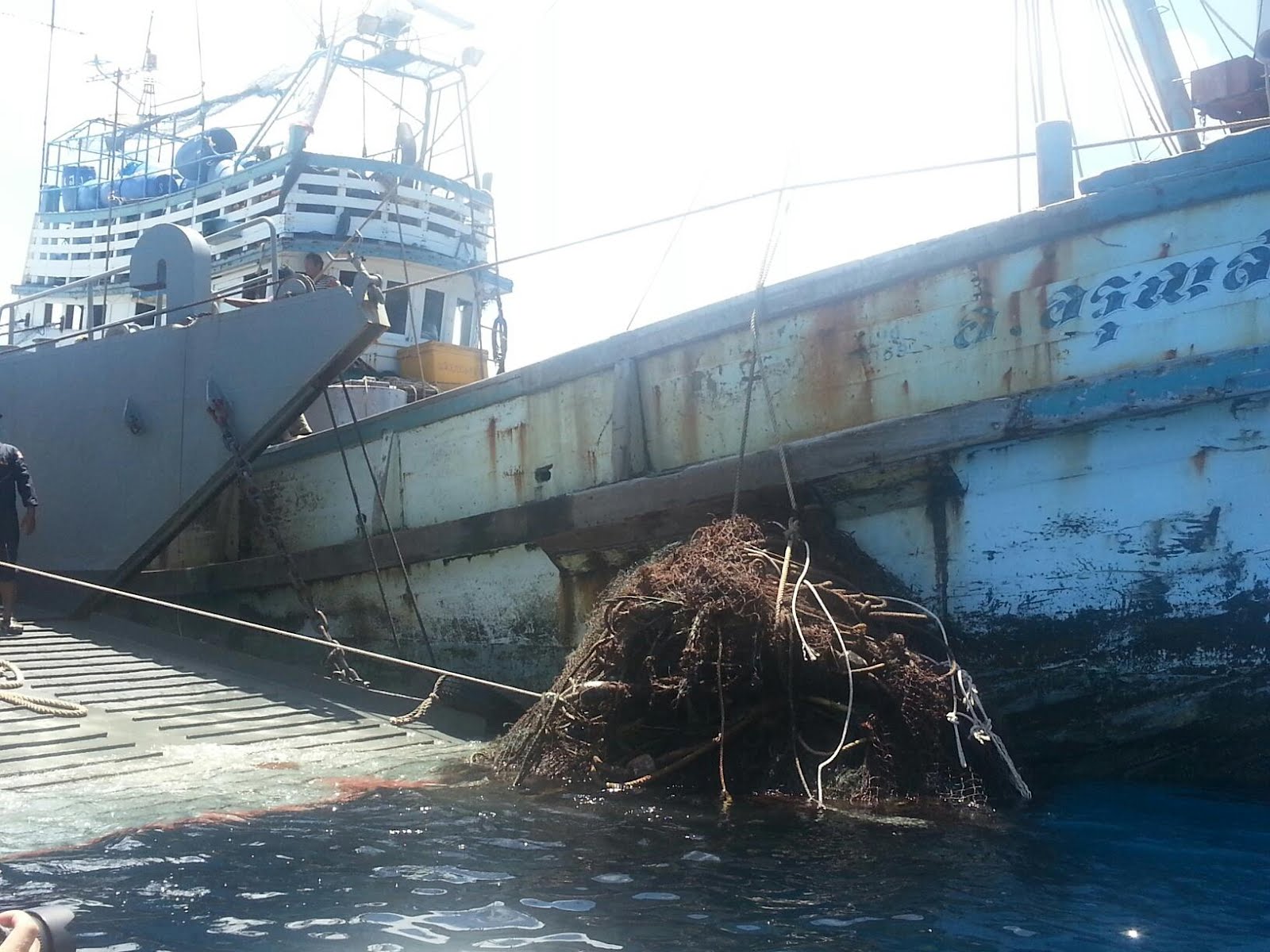
Last Sunday, 30th September, 14 dive boats with more than 500 volunteers turned out to clean the reefs of Koh Racha Noi and Yai, Koh Khao Nok and Koh Hei in Go Eco Phuket's "Dive for Debris" initiative. They managed to collect an amazing 15 tons of debris including a 4.5 discarded fishing net, which even a local fishing boat helped to haul in. This was a united effort from local dive operators, local resorts and tourism dependent businesses, government agencies and the Royal Thai Navy.
Tony Andrews, PADI Regional Manager and Project AWARE Ambassador, said “It’s a record. Obviously we are very pleased with the event." He explained that the debris would be sorted into categories, such as fishing nets, plastics and so on, so it can be accurately documented.
The long-term goal of the event is to mobilize divers from around to the world to return the reefs to a clean, healthy state.
“We had a strong dream of making the reefs of Phuket and the surrounding islands clean, pristine and sustainable, and making sure they belong in the top diving destinations in Thailand and the world,” Mr Andrews said.
Vice Admiral Taratorn Kajitsuwan, Commander of the Navy Third Area Command at their base at Cape Panwa, pointed out that when Prime Minister Yingluck Shinawatra previously visited Phuket, she had made it clear that eco-tourism was a must for the island.
“One of my priorities is to help [support eco-tourism efforts], and this project goes hand in hand with PM Yingluck’s vision of improving tourism and our country,” he said.
“Everyone is glad that Thais and foreigners have so much interest in the local environment,” he added.
The important thing is what happens now. The founders of Go Eco Phuket are already discussion their next project, and we will keep you posted on any upcoming event :)
The problem with marine debris
Every year, tens of thousands of marine animals and seabirds die from eating or getting tangled up in marine debris. Here’s the ugly and frightening truth surrounding our mass throwaway culture:
* Almost 90 per cent of floating marine debris is plastic.
* Over 6 million tonnes of marine litter could be entering our ocean every year.
* Research of northern fulmar seabirds found dead on beaches showed 95 per cent had plastic in their stomachs. Each bird had swallowed an average of 35 plastic pieces.
* 35 per cent of plankton-eating fish found during a study in the North Pacific Central Gyre had ingested plastic.
* Annual plastic production and use of plastics has risen from 1.5 million tonnes in 1950 to 230 million tonnes in 2009.
* Marine debris has affected more than 260 different marine species, including 86 per cent of sea turtles, 28 per cent marine mammals and 36 per cent of seabirds.
* The majority of marine wildlife deaths are due to eating marine debris.
* Animals that eat marine debris can choke if it catches in their throat. Once swallowed, plastic cannot be digested and makes the animal feel like it is full, so it stops eating and can starve to death.
Friday, September 28, 2012
Phuket Dives: Anemone Reef
As the name suggests, Anemone Reef (or Hin Jom as it is known in Thai), is literally covered in magnificent anemones which play host to a variety of anemonefish and clownfish, but a dive at Anemone Reef is more than just pretty anemones.
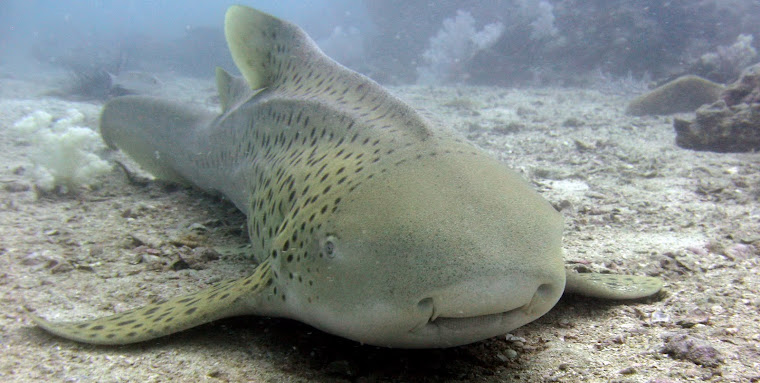
This submerged rock is located less than a mile north of Shark Point. The top of the pinnacle is around 3m, and slopes down to around 25m where there is a sandy bottom.You can often see leopard sharks resting down here, also look out for Kuhl's stingrays, bent-stick pipefish and peacock mantis shrimp. On the pinnacle are some huge gorgonian seafans, lots of whip coral, and the soft corals are beautiful! Have a look inside the barrel sponges - you can sometimes see big bearded scorpionfish chilling out in there. There are plenty of macro things to look for here too - cleaner shrimp, coral banded shrimp, durban dancing shrimp, different kinds of nudibranc's and flatworms, tigertail seahorses, and ornate ghost pipefish.This site is covered in moray eels too, have a look for honeycomb, zebra, fimbriated, giant, white-eyed and snowflake morays.
There are big schools of fish that like to hang out - lots of snapper, grouper and fusiliers, also look out from the pinnacle you can often see schools of big fin reef squid. Soldierfish gather together in crevices or under overhangs, and there are plenty of common and spotfin lionfish. Also keep an eye out for the hawksbill turtles which are often seen here.
This is a pretty small site so take your time as much as possible. If there is current present, you may stick to one side of the pinnacle to shelter and then zig-zag your way to the top which is a perfect depth for your safety stop at the end of your dive :)
Monday, September 24, 2012
PADI Advanced Open Water Course
This is for you if you’ve done the Open Water course and now you want to continue to develop your diving skills and be more confident in the water.
This course lets you try out 5 different specialty dives... deep, navigation (which you have to do) and 3 others (wreck, night, photography, peak performance buoyancy, AWARE Fish ID etc).
It is a hugely worthwhile course because it also allows you to dive to a maximum of 30 metres, instead of the limiting 18 metres of open water diver. Many liveaboard companies require that you have this rating to join their cruises (or complete it during the cruise) as it shows that you have a better understanding of diving theory and that you have a bit more experience. The best thing about this course is that there's no exam :) You will receive a manual and you will be required to read the chapters which correspond to the specialties that you have chosen to learn more about, and complete a short knowledge review at the end of each chapter - easy!
This rating is required if you plan to go on and pursue the PADI Rescue Diver course.
This course can be done on Phuket Daytrips, Phi-Phi Overnight Special or Liveaboard Trip - contact us for prices and more information info@calypsophuket.com :)
Friday, September 21, 2012
*Fascinating Fish Fact*
The seahorse (Hippocampus) is one of my favourite fish to see when I'm diving. They are found in tropical and temperate waters throughout the world, and range in size from 1.5-35cm. Here are some facts about these unique fish:
Seahorses are fish
After much debate, scientists have decided that seahorses are indeed fish. They belong in the Class Actinopterygii, the bony fish, which also includes larger fish such as cod and tuna. Unlike most other fish though, they do not have scales, only skin covering them.
Seahorses are bad swimmers
Seahorses prefer to rest in one area, sometimes hanging on to a piece of coral for long periods of time using their prehensile tails. They are however very maneuverable and are able to move up, down, forwards and backwards.
There are 53 known species worldwide
- according to the World Register of Marine Species. They are catergorised in the family Syngnathidae which includes pipefish and seadragons.
Seahorses eat almost constantly
They feed on plankton and small crustaceans, but do not have a stomach so the food passes through them very quickly causing the need to eat all the time.
Many seahorses mate for life
Many are monogamous, meaning they mate for life. The male and female have an elaborate, daily courtship ritual, involving a "dance" where they entwine their tails, and may change colors.
Male seahorses give birth
Unlike any other species, the males become pregnant. Females insert her eggs into the male's brood pouch. The male wiggles to get the eggs into position. Once all the eggs are inserted, the male goes to a nearby coral or seaweed and grabs on with his tail to wait out gestation, which may last several weeks. When it's time to give birth, he'll contort his body in contractions, until the young are born, sometimes over a period of minutes or hours. Baby seahorses are miniature versions of their parents.
Seahorses are experts at camouflage
Some seahorses, like the pygmy seahorse, have a shape, size and colour that allows them to blend in perfectly with their habitat. Others, such as the thorny seahorse, change colour to blend in with their surroundings.
Seahorse populations in Asia are in decline
This can largely be attributed to the use of seahorses in Asian medicines. There is no clinical proof that seahorses have any medicinal benefits, so please avoid buying any of these remedies.
Seahorses like to talk
They make clicking noises when interacting with other seahorses :)
Tuesday, September 18, 2012
Phuket Dives: Koh Doc Mai
Koh Doc Mai, which translates to Flower Island in English, is a small limestone island located between Phuket and Shark Point. The underwater topography is very similar to what you can see above water - the east side is a shallower, sloping coral garden, the west is a fabulous wall dive, and the side that we normally dive on. If you like macro dives, you won't be disappointed here, we regularly see tiger-tail seahorses, cleaner pipefish,
a variety of moray eels, frogfish, octopus, cuttlefish, ornate ghost pipefish, different kinds of nudibrancs, as well as a host of different kinds of shrimps - cleaner shrimp, durban dancing shrimp, coral banded shrimp, tapestry shrimp, and harlequin shrimp.
If you have a look in the cracks and crevices in or at the bottom of the wall you may also be able to spot a bamboo shark - sometimes you can see a few of them squeezed in together resting in preparation for their nocturnal hunting.
If that isn't enough for you, there are plenty of reef fish along here, all the usual suspects - butterflyfish, angelfish (have a look for juveniles of the blue ringed and emporer angelfish), bearded scorpionfish, lionfish, rabbitfish, etc, and also look out from the wall for schools of longfin trevally, chevron and forster's barracuda...and, if they are in the area, it's not unusual to see whale sharks hanging around this island :)
To add to all this (as if you need more!) there are also two caves. The northern cave entrance is quite small and can be difficult to get in and out of, so this is suitable only for more experienced divers. However, the southern cave has a bigger entrance and is more easily navigated by newer divers...but always remember to check your air and decompression time before entering any enclosed space!
We have trips every day which take in Koh Doc Mai so contact us if you'd like to check out this spectacular dive - info@calypsophuket.com :)
Friday, September 7, 2012
PADI Open Water Course
If you love the water and have always wanted to try diving, this is the course for you. This is your first and most important step in becoming a certified Open Water diver who can dive independently, without the guidance of a professional. Try it and you’ll never turn back.
As a certified PADI Open Water Diver, the most widely recognized and respected rating in the world, you have the freedom to dive with a buddy independent of a professional. If you already tried a PADI Discover Scuba Diving experience or are PADI Scuba Diver certified, check with your instructor to see how credit from these courses may apply to the open water diver program.
What do I need to start?
Virtually anyone who is in good health, reasonably fit, comfortable in the water and can swim 200 meters can earn a PADI Open Water Diver certification. If you are between 10 and 14 or have a child between these ages, check out the PADI Junior Open Water Diver program.
How long will it take?
PADI programs are performance based. You proceed as you demonstrate mastery of the course skills. This allows you to work at a pace that is comfortable for you. The usual duration is 3 or 4 full days.
What will I do in this course?
Throughout the course, you’ll learn the fundamentals of scuba diving, including dive equipment and techniques. You earn this rating by completing five pool dives and knowledge development sessions and by making four open water (ocean) dives. Please contact us directly via email if you have special needs.
What can I do after this course?
You can go on with your dive adventure and do several Adventure Dives. These will give you a fun and quick way to sample many different specialty diving techniques in one Adventure Diver course. If you do five Adventure Dives you qualify for the PADI Advanced Open Water certification.
What do I need to bring?
All of the diving equipment is available from us however, you are welcome to bring or purchase your own. Do bring your swimsuit, sunscreen and towels.
Sample Itinerary
Day 1: Classroom & Pool
Day 2: Two Boat or Beach dives
Day 3: Two Boat or Beach dives
Contact us for prices and availability...info@calypsophuket.com :)
Subscribe to:
Posts (Atom)